Clinical protocols,
versioned like software.
Governed like medicine.

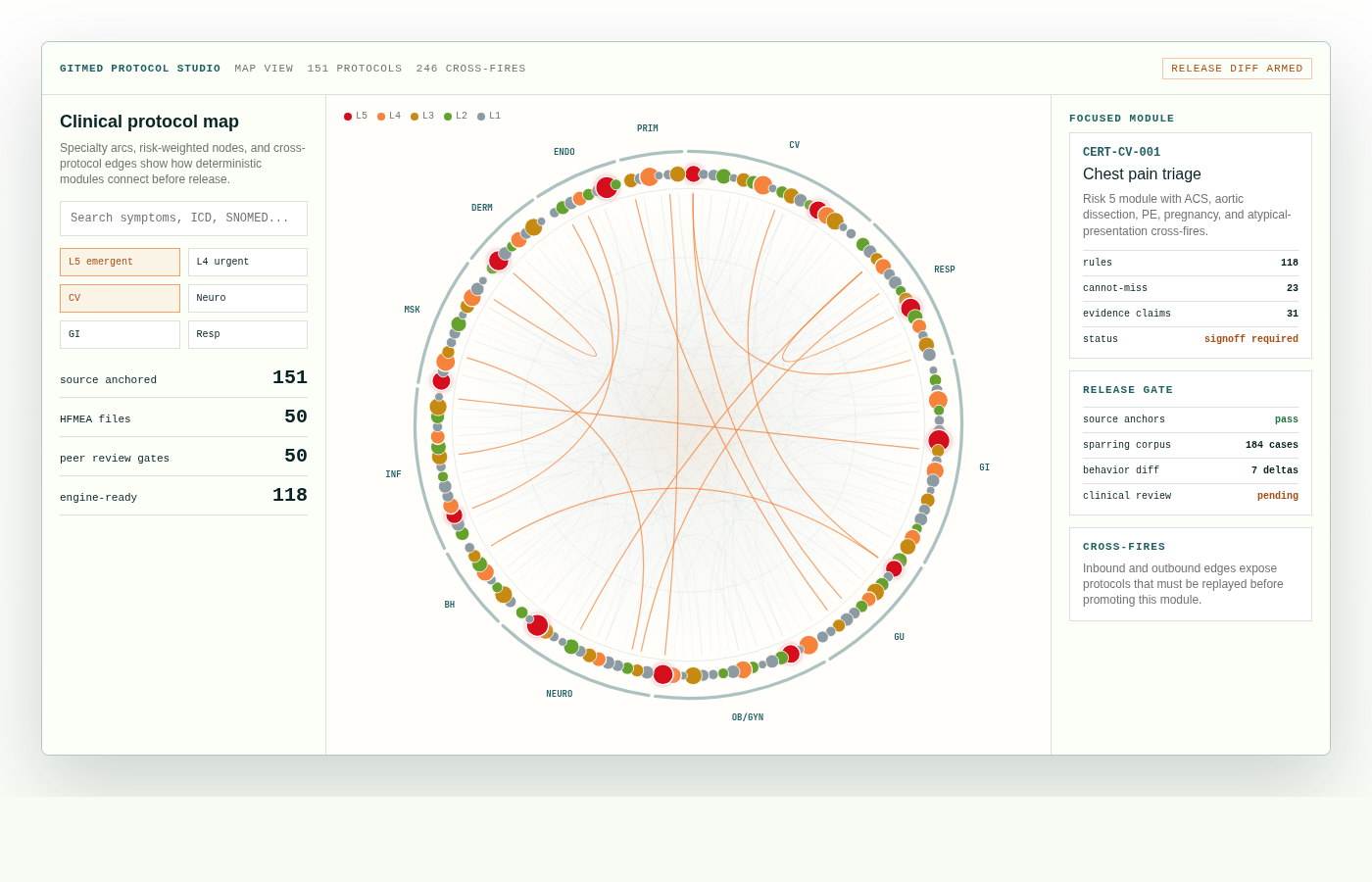
Screenshot-style Protocol Studio map with specialty arcs, risk nodes, cross-protocol edges, and release gate details

GitMed is the Auddax suite for the clinical protocol supply chain: authoring, source anchoring, simulation, red-team testing, clinical review, release diffing, signoff, and post-release monitoring.

Teams use GitMed to treat every deterministic clinical pathway as governed software. Protocols can be authored, tested, compiled, versioned, and released without turning the diagnostic pathway back into open-ended model generation.

gitmed release workflow signoff req
$ gitmed init adult_sinusitis --template diagnostic-triage
created protocols/adult_sinusitis/protocol.yaml
created protocols/adult_sinusitis/sources.yaml
created protocols/adult_sinusitis/evals/red_flags.yaml

$ gitmed plan \
  --from adult_sinusitis@0.1.0 \
  --to protocols/adult_sinusitis \
  --out .gitmed/plans/adult_sinusitis-0.2.0.json
changed_questions: 4
changed_dispositions: 2
new_exclusions: 1
required_signoffs: clinical, safety

$ gitmed release gate .gitmed/plans/adult_sinusitis-0.2.0.json
source_anchored: pass
sparring_suite: pass
clinical_review: pending

GitMed is the protocol layer inside the Auddax platform.

Auddax governs model-powered medical products end to end. GitMed owns the protocol supply chain that produces deterministic clinical modules. SignalOS governs source data, sensitive-data custody, and clinical permissions. ClearanceOS packages the evidence, risk controls, traces, and change plans those products need for regulated review.

Auddax

Runtime harness, model contracts, clinical CI, traceability, SDKs, and qualification infrastructure.

GitMed

Protocol Studio, Case Forge, clinical review, release diffs, source anchoring, and module registry.

SignalOS

Signal normalization, Vault manifests, consent scope, privacy-risk gates, fact permissions, and monitoring.

ClearanceOS

Regulatory readiness workspace for evidence files, risk controls, change plans, and submission exports.

Author and inspect clinical pathways as governed software modules.

Protocol Studio gives clinical, engineering, and safety teams a shared surface for deterministic pathways. Each module carries intended use, supported population, required facts, exclusion criteria, red flags, output states, trace requirements, source references, tests, and release status.

GitMed Protocol Studio map showing risk-weighted clinical protocols and cross-protocol edges
  • Protocol map Specialty arcs and cross-protocol edges reveal where a pathway interacts with adjacent modules.
  • Deep detail Rule counts, cohorts, scoring tools, HFMEA risks, citations, FHIR artifacts, and DSL inventory stay linked.
  • Release state Every module shows whether it is draft, review, pilot, production, deprecated, or blocked by findings.

Every clinical rule points back to a source or rationale.

GitMed treats references as first-class protocol infrastructure. Guidelines, care pathways, institutional policies, validation papers, and clinical rationale become structured inputs that can be checked, reviewed, refreshed, and exported as evidence.

Artifact What it proves Release use
Rule source Guideline, policy, paper, or clinical rationale behind the rule Blocks release if missing
Bibliography Canonical citations, DOI/PMID, review status, and curator notes Evidence export
Clinical claim GRADE, population, intended use, and source-backed limitation Claim verification
Source drift Changed guideline, expired review cadence, or unresolved citation gap Review trigger

Adversarial cases turn hidden failures into validation work.

GitMed can generate synthetic and adversarial cases with hidden ground truth, replay them through a clinical workflow, and judge whether the pathway missed a red flag, selected the wrong cohort, overreached, or changed disposition. Failures become test cases and review items, not silent product debt.

Patient variation

Vague symptoms, minimization, contradiction, missing facts, comorbidities, language, and demographic strata.

Red-team runs

Prompt injection, rare red flags, edge presentations, cross-protocol ambiguity, and out-of-scope cases.

Corpus view

Pass rates, confusion pairs, calibration deltas, cannot-miss recall, and subgroup performance.

Clinical queue

Clustered failures route to protocol changes, new tests, model-role evaluation gaps, or reviewer signoff.

case forge failure clustered
$ gitmed sparring run chest_pain@2.4.0 \
  --suite rare-comorbidity \
  --model-role intake.extractor
case_id: sp_8b2d
scenario: atypical_acs_woman
expected_state: emergent_911
observed_state: urgent_clinician_review
cannot_miss_recall: 0.82
result: fail

$ gitmed sparring cluster \
  --module chest_pain \
  --since candidate-2026.05.07
clusters: 6
new_test_candidates: 18
protocol_change_candidates: 3
model_role_eval_gaps: 4

Clinical behavior changes are explicit before they ship.

GitMed compares protocol versions the way engineering teams compare code, but with clinical semantics: changed questions, dispositions, thresholds, exclusions, red flags, source claims, output states, and handoff behavior.

Gate What GitMed checks Outcome
Behavior diff Which clinical states, questions, dispositions, and exclusions changed Reviewer can inspect deltas
Safety replay Regression cases, red flags, edge cases, and cross-protocol dependencies CI pass or block
Source check New and changed rules remain source anchored Missing rationale blocks release
Signoff Clinical, safety, and product owners acknowledge the release Promote or hold
release diff review required
$ gitmed release diff chest_pain@2.3.1..chest_pain@2.4.0 --format yaml
module: chest_pain
from: 2.3.1
to: 2.4.0
clinical_delta:
  changed_questions: 5
  changed_dispositions: 3
  new_exclusions: 2
  new_red_flags: 1
source_claims_changed: 4
cross_protocol_replays:
  - syncope
  - dyspnea
  - upper_abdominal_pain
required_signoffs:
  - cardiology
  - safety
  - release_owner

Findings, signoffs, and overrides become governed work.

GitMed gives reviewers a structured queue for protocol findings, source issues, unresolved sparring failures, clinician overrides, and release signoffs. Critical findings can block a protocol version until they are resolved, declined with rationale, or routed to higher review.

  1. 01 Findings
    Protocol-version issues anchored to rule, citation, cohort, source, test, or clinical claim.
  2. 02 Specialty review
    Reviewer assignment, specialty match, conflict notes, attestations, and rescission where needed.
  3. 03 Override compiler
    Clinician disagreement clusters become protocol-change candidates, new tests, or model-role evaluation gaps.
  4. 04 Audit trail
    Every review decision and release action is preserved for traceability and ClearanceOS evidence exports.

Every released module carries its evidence graph forward.

A GitMed release records the exact protocol version, source set, deterministic artifact, validation suite, sparring corpus, clinical signoffs, behavior diff, release decision, and runtime qualification. Auddax traces and ClearanceOS evidence files can then reference the same governed record.

protocol registry qualified
$ gitmed registry show chest_pain@2.4.0 --evidence-graph --format yaml
protocol: chest_pain@2.4.0
artifact_digest: sha256:9f4c2e...
intended_use: adult chest pain triage support
sources: 31 verified
hfmea_record: linked
sparring_corpus: chest_pain_regression@2026.05
clinical_signoffs:
  - cardiology
  - emergency_medicine
qualified_environments:
  - sandbox
  - staging
clearanceos:
  evidence_file: linked

GitMed produces the protocol evidence, release diffs, clinical signoffs, validation records, and post-launch change candidates that ClearanceOS organizes for regulated review.

GitMed turns protocol growth into governed release work.

Teams can expand clinical coverage without letting the pathway become prompt content. GitMed gives Auddax customers a protocol studio, adversarial testing loop, evidence graph, and review system for deterministic medical AI modules.

GitMed by Auddax

Protocol Studio, Case Forge, release diffs, clinical review, evidence graph, and registry.

brief@auddax.ai